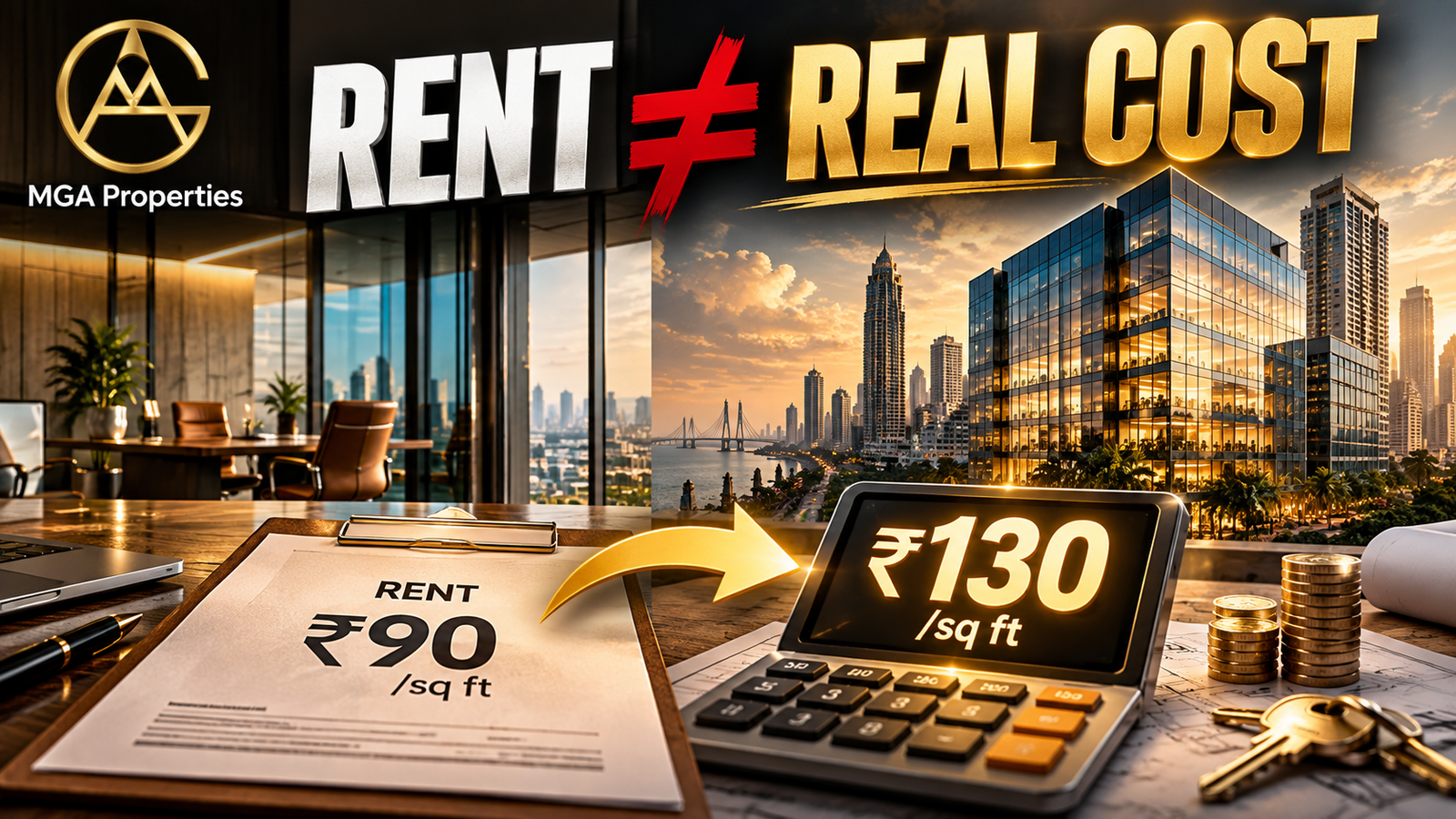
"The rent on the listing is the opening offer in a conversation. By the time you sign, you are paying for six other things that were never on the listing at all."
A business owner once told us she had budgeted Rs 90 a square foot for her new office and felt good about the number. Three months later, her actual monthly outflow was closer to Rs 130 a square foot once everything landed on her desk. Nobody had lied to her. Nobody had hidden a clause. She had simply never been shown the full bill before, because nobody shows you the full bill before.
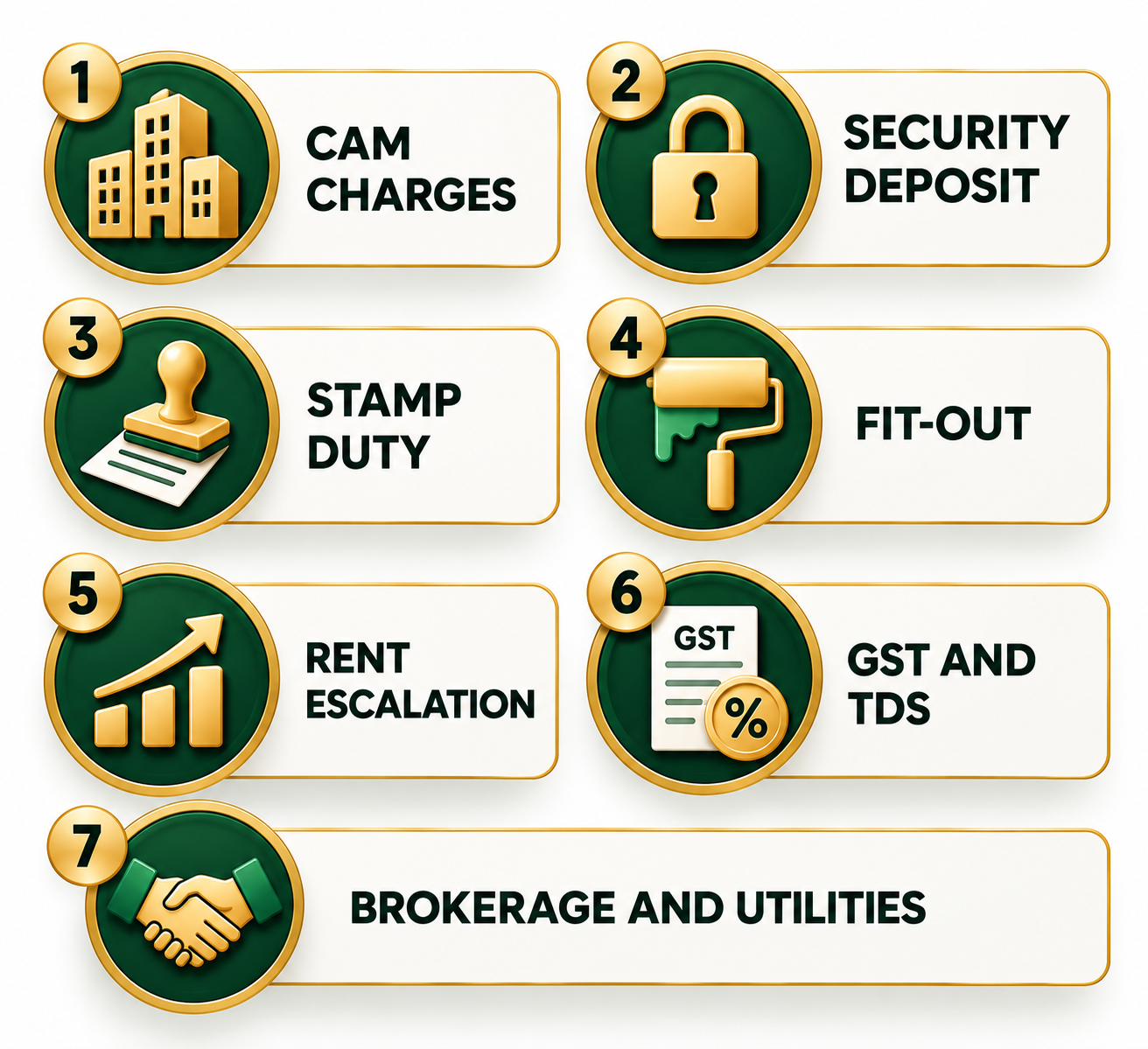
This article lists the seven costs that routinely get left out of the conversation when business owners rent commercial property in Mumbai. None of them are secret. All of them are easy to miss if you are reading a listing instead of a lease. If you are also weighing whether to rent at all, our guide to leasing versus renting versus coworking is worth reading alongside this one.
We are not arguing against renting commercial space. Plenty of businesses genuinely need a dedicated floor, and for them, renting remains the right call. The point of this article is narrower: know the full bill before you negotiate, not after you have already signed. A number you see coming is a number you can push back on. A number that arrives as a surprise rarely gets negotiated at all.
Why the Rent Figure on the Listing Is Never the Real Number
A listing exists to get you interested, not to show you a complete budget. Brokers quote the base rent because it is the number that makes a space look affordable next to its neighbours. Everything that gets added afterward, maintenance, deposit, taxes, fit-out, tends to arrive one conversation at a time, so no single moment feels like the full shock.
The real number in one line
Treat the quoted rent as the floor of your cost, not the ceiling. The true monthly figure is almost always higher once every line item is added, and knowing that upfront changes how you negotiate.
Hidden Cost #1: CAM or Maintenance Charges
Common area maintenance, usually called CAM, covers the upkeep of lobbies, lifts, security, common lighting, and shared utilities in the building. It is billed separately from rent, typically per square foot per month, and landlords rarely mention it in the headline number because it technically is not rent.
On a mid-grade commercial building, CAM commonly runs Rs 5 to 15 per square foot per month. On a 1,000 square foot office, that is Rs 5,000 to 15,000 a month that never appeared in the listing you first saw.
Premium buildings with a full-time facility management team, backup power, and higher-grade security tend to sit at the top of that range or above it. Before you sign, ask exactly what CAM covers in that specific building, what it does not cover, and whether the figure has increased in each of the past few years. A landlord who cannot answer that last question plainly is one worth asking harder questions of.
Hidden Cost #2: The Deposit You Never Get to Use
A security deposit of six to ten months' rent is standard in Mumbai. The money is refundable, but it sits with your landlord for the length of your lease, earning nothing for you and unavailable for anything your business might actually need it for. On a Rs 1,35,000 monthly rent, an eight-month deposit locks up Rs 10,80,000 that could otherwise be working capital.
The Real Cost of Tied-Up Capital
Even a conservative return on that capital, invested elsewhere in the business, adds a real monthly cost that most budgets never account for. It is not a fee you pay, but it is money you do not get to use, which amounts to the same thing on your balance sheet.
The size of the deposit is also one of the more negotiable numbers in the entire agreement, particularly for a tenant with a strong financial track record or a well-known business name. Landlords often ask for ten months as an opening position precisely because many tenants never push back. Asking for six instead, or offering a slightly longer lock-in in exchange for a smaller deposit, is a completely normal negotiation in this market.
Hidden Cost #3: Stamp Duty and Registration
Commercial lease agreements in Maharashtra need to be stamped and registered, and the stamp duty is calculated on the average annual rent across the full lease term, not just the opening year. On a lease with built-in escalation, that pushes the calculation higher than most tenants expect. Confirm the current rate and method directly on the state's official stamp duty portal before you budget, since figures change periodically.
Registration carries its own separate fee on top of the stamp duty itself. Skipping registration to save money is a false economy, because an unregistered lease is far weaker to enforce if a dispute ever comes up later.
This is also one of the costs most business owners budget for incorrectly, if they budget for it at all. Because it is a one-time payment made before the lease even starts, it is easy to mentally file it under setup costs and forget to include it in any ongoing comparison against alternatives. Add it to your total cost of occupancy the same way you would add fit-out, as a number spread across the length of the lease, not a cost that disappears after the first month.
Hidden Cost #4: Interior Fit-Out
Most commercial space in Mumbai is handed over bare or semi-finished. Flooring, lighting, partitions, air conditioning, cabling, and a pantry setup are all the tenant's responsibility and the tenant's cost. Even a modest, functional fit-out for a small office commonly runs into several lakhs, and research houses like knightfrank.co.in regularly note fit-out as one of the largest upfront costs tenants underestimate when comparing office options.
Spread over a three-year lease, a fit-out of Rs 6 lakhs adds roughly Rs 16,700 a month to your true cost, even though you only wrote one cheque for it. Budgeting it as a monthly figure, not a one-time number, gives you a far more honest comparison against other options.
What If You Leave Before the Lease Ends
Fit-out is rarely recoverable. Flooring and partitions built for your specific layout are of little use to the next tenant, and most landlords do not compensate you for leaving them behind. If there is any real chance your team outgrows or outlasts the space before the lease term is up, factor that risk into the decision, not just the upfront number. A shorter initial term, even at a slightly higher rate, sometimes works out cheaper once you price in this risk honestly.
Hidden Cost #5: Rent Escalation Clauses
Almost every commercial lease carries a built-in escalation clause, typically 10 to 15 percent every two to three years. A rent that feels reasonable in year one can be meaningfully higher by year four, and that increase is locked into the agreement whether your business has grown enough to absorb it or not. Market trackers such as cbre.co.in publish typical escalation bands for Indian commercial markets, and they are worth checking before you accept whatever a landlord first proposes.
Model the whole lease term, not just year one
Before signing, calculate what your rent looks like in the final year of the lease, not just the first. A clause that looks small annually can add up to a large jump by the time your lock-in ends.
Take a five-year lease starting at Rs 90 per square foot with 12 percent escalation every two years. By year five, your rent per square foot has climbed to roughly Rs 113, a 25 percent increase from where you started, locked in before you had any say in the matter. Run this calculation for every lease you consider, because the headline rent on two spaces can look identical while their fifth-year numbers are miles apart.
Hidden Cost #6: GST and TDS Compliance
Commercial rent generally attracts GST, and while a registered tenant can usually claim input tax credit on it, that only works if your paperwork is correct from day one. Confirm current applicability and rates on gst.gov.in before you finalise your budget.
Separately, tenants paying rent above a certain threshold must deduct TDS under Section 194-I, and missing this obligation creates compliance problems well after the lease is signed. Current thresholds are listed on incometax.gov.in. If your business entity itself needs a registered office address sorted out at the same time, the requirements are detailed on mca.gov.in. For hands-on help with any of this, our note on CA and GST advisory support covers what that kind of guidance looks like in practice.
Neither of these is a reason to avoid renting. Both are entirely manageable once you know they exist, and a competent accountant handles them as routine compliance rather than a crisis. The problem only arises when a business owner discovers these obligations after the fact, during an audit or a notice, rather than building them into the lease decision from the outset.
Hidden Cost #7: Brokerage, Utility Deposits, and Parking
Brokerage in Mumbai is typically one month's rent, paid once at signing but easy to forget when you are focused on the monthly numbers. Utility providers often ask for their own security deposits before connecting power and water in a commercial unit. And parking, if you need it, is frequently billed as a separate monthly charge rather than bundled into rent. Office market reports from firms like jll.co.in regularly flag these smaller line items as the ones tenants are most likely to miss in their first budget.
None of these individually breaks a budget. Together, they can add a meaningful percentage to your true monthly cost before you have accounted for a single square foot of actual rent. Ask about all three in the same conversation, because brokers and landlords rarely volunteer them together, and each one sounds smaller in isolation than it is in combination.
The Real All-In Cost: A Worked Example
Here is how these seven costs stack up for a 1,000 square foot office at Rs 90 per square foot, over the first 12 months. The figures are illustrative assumptions, so replace them with real quotes before you budget your own space.
| Cost item | Monthly equivalent |
|---|---|
| Quoted rent | Rs 90,000 |
| CAM (about Rs 10/sq ft) | Rs 10,000 |
| Cost of deposit tied up | Rs 4,500 |
| Stamp duty, amortised | Rs 2,800 |
| Fit-out, spread over 36 months | Rs 16,700 |
| Brokerage and utility deposits, amortised | Rs 4,000 |
| True monthly cost | about Rs 1,28,000 |
That gap, roughly 42 percent above the quoted figure, is the exact reason so many smaller teams end up comparing a traditional lease against renting meeting rooms by the hour instead, once they see the full picture.
How to Negotiate These Costs Down
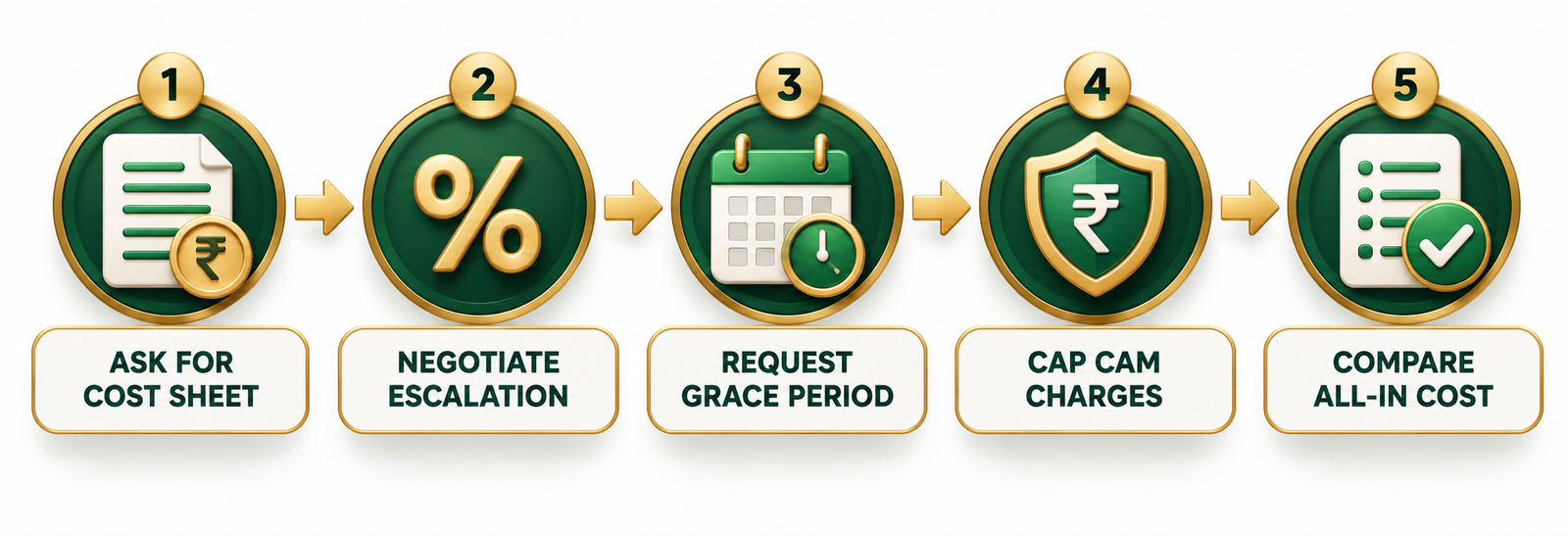
None of these seven costs are fixed in stone. Most are negotiable if you know to ask before you sign rather than after. The leverage you have is largest before you have fallen in love with a specific space, which is exactly when most tenants forget to use it.

Ask for the full cost sheet upfront
Request CAM, deposit, stamp duty estimate, and any other charges in writing before you get emotionally attached to a space.
Negotiate the escalation clause
Push for a lower percentage or a longer cycle, especially if you are offering a longer lock-in in return.
Ask for a fit-out grace period
Many landlords will waive rent for the first one to two months while you build out the interior, if you simply ask.
Get CAM charges capped
Some landlords will agree to cap annual CAM increases, which protects you from a second kind of escalation hiding inside maintenance.
Compare the all-in number, not the rent
Once you have every figure, compare it against alternatives like a flexible workspace before committing to a multi-year lease.
Mistakes Business Owners Make When Signing
Most of these mistakes share a common root: they happen because the pressure to find a space and move in collides with the discipline needed to read every clause carefully. Slowing down at the signing stage, even by a week, is one of the cheapest insurance policies available to a business owner.
Budgeting only on the quoted rent
Treating the listing price as the full cost, then discovering the real number a few invoices later.
Not modelling the final year of the lease
Signing without checking what escalation does to rent by year three or four of the term.
Skipping lease registration to save money
Leaving an agreement unregistered, which weakens your position if a dispute ever arises.
Ignoring the location trade-off
Choosing on rent alone without checking how the location compares against other business districts for your specific needs.
On that last point, if you are deciding between cities as well as buildings, our comparison of Mumbai, Bangalore, and Delhi is worth a read before you commit to any single market.
Why Knowing This Upfront Changes Your Decision
You negotiate from strength
Knowing every line item before you walk into a meeting means you can push back on specific numbers, not just the headline rent.
You compare options fairly
An all-in monthly figure lets you compare a lease against coworking or a managed office on equal terms.
You protect your cash flow
Knowing the real upfront cost before you commit prevents a nasty surprise that eats into working capital.
You avoid locking into a bad escalation
Modelling the full lease term stops you from signing a deal that looks fine in year one and painful in year four.
How MGA Properties Can Help
If the all-in cost of a traditional lease gives you pause, MGA Properties offers alternatives in Andheri West that remove most of these hidden costs entirely.
| What You Need | How We Help | Link |
|---|---|---|
| Furnished space with no fit-out or deposit shock | Move into a ready coworking floor with one predictable monthly fee | Coworking Space |
| A registered address without CAM or stamp duty | A prime Mumbai address with GST-ready documentation included | Virtual Office |
| A room for client meetings without an office lease | Fully equipped meeting rooms, booked by the hour | Meeting Rooms |
| To own instead of renting long term | Explore fractional and direct commercial ownership routes | Smart Buying |
Frequently Asked Questions
What are the hidden costs of renting commercial property in Mumbai?
The most common hidden costs are CAM or maintenance charges, the opportunity cost of a large security deposit, stamp duty and registration, interior fit-out, rent escalation clauses, GST and TDS compliance, and brokerage plus utility deposits.
What is CAM charge in a commercial lease?
CAM, or common area maintenance, is a charge landlords collect to maintain shared spaces like lobbies, lifts, security, and common utilities. It is usually billed per square foot per month, separately from rent.
How much is stamp duty on a commercial lease in Mumbai?
Stamp duty is calculated on the average annual rent over the lease term, not just the first year, and rates can change. Confirm the current calculation on the official government stamp duty portal before budgeting.
Is GST applicable on commercial rent in Mumbai?
Commercial rent generally attracts GST, and a GST-registered tenant can usually claim input tax credit on it. Confirm current rules on the official GST portal before signing.
Do tenants need to deduct TDS on commercial rent?
Tenants paying rent above a certain threshold must deduct TDS under Section 194-I of the Income Tax Act. Confirm current thresholds on the official Income Tax Department portal.
How much should I budget for fit-out on a commercial office in Mumbai?
A basic functional interior for a small office commonly runs into several lakhs. Spreading that cost over the lease term gives a clearer picture of the true monthly cost.
Can rent escalation clauses be negotiated?
Yes. Many landlords are open to capping the escalation percentage or extending the cycle, especially in exchange for a longer lock-in. Negotiate this before signing.
Is renting always cheaper than coworking in Mumbai?
Not necessarily. Once CAM, deposit, stamp duty, fit-out, and escalation are added, the true monthly cost often moves much closer to a coworking seat price for smaller teams.
Final Thoughts
Go back to the business owner who budgeted Rs 90 a square foot and paid Rs 130. Nothing illegal happened to her. Nobody hid a clause in fine print. She simply never asked for the full picture before she signed, and nobody offered it voluntarily.
The fix is simple even if it is rarely done: ask for every number before you commit, model the full lease term, and compare the all-in monthly figure against every alternative available to you. Seven hidden costs become a lot less hidden the moment you know to ask about them.
If you want help working through the real numbers on a Mumbai commercial space, reach out through our contact page and we will walk you through it before you sign anything.