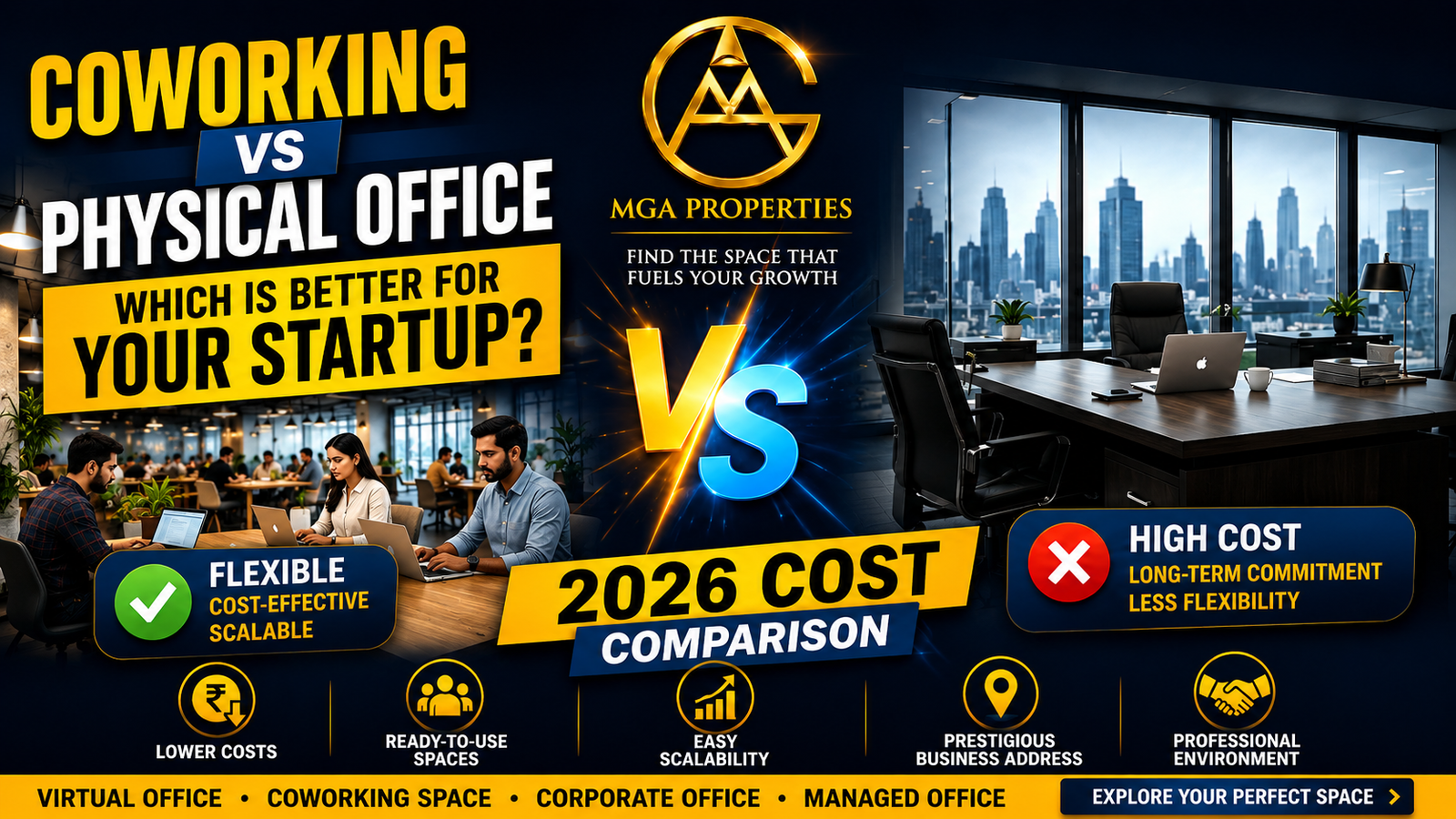
Every founder eventually hits the same fork in the road: sign a lease for a physical office, or move into a coworking space. It feels like a small operational decision, but it is actually one of the biggest financial choices a startup makes in its first few years. Get it wrong, and you tie up capital you desperately need for hiring and growth. Get it right, and you free up cash, move faster, and still look completely professional in front of clients and investors. This guide breaks down the real 2026 numbers behind coworking vs physical office, so you can decide with facts instead of assumptions.
Coworking vs Physical Office: The Core Difference
A physical office is space you lease, furnish, and manage entirely on your own. You are responsible for the deposit, the interiors, the internet connection, the electricity bill, the housekeeping staff, and every repair that comes up along the way. A coworking space flips that model. You pay one membership fee, and a shared infrastructure of desks, internet, meeting rooms, and support staff is already built, tested, and ready to use from day one. The underlying question is not really "which is nicer." It is "who should be carrying the operational and financial risk of running an office: you, or the workspace provider?"
For a founder juggling product, sales, hiring, and fundraising at the same time, that distinction matters far more than the square footage on a floor plan.
Rent: What You Actually Pay Each Month
On paper, a traditional office lease looks like a simple per-square-foot number. In reality, that number is only the starting point. In most Indian metro business districts, commercial rent for a small team ranges widely depending on location and building grade, and landlords typically expect annual escalation clauses of 5 percent or more built into multi-year agreements. Coworking pricing, by contrast, is usually quoted as a flat seat or desk price per month, with no separate escalation clause hidden in the fine print. That predictability alone makes budgeting significantly easier for an early-stage company.
Security Deposits: The Capital Trap
This is where physical offices hurt the most. Landlords commonly ask for 6 to 12 months of rent as an upfront security deposit. For a mid-sized team, that can mean several lakhs of rupees sitting locked away for years, earning no return and unavailable for anything else. Coworking spaces typically ask for a fraction of that, often just one or two months, because the provider is not handing over an entire empty shell for you to build out. That difference alone can be the deciding factor for a startup trying to stretch its runway.
Interiors and Fit-Out Costs
A bare-shell physical office needs flooring, false ceilings, partitions, electrical wiring, furniture, air conditioning, and a network setup before anyone can actually sit down and work. Depending on the finish level, that fit-out bill can easily run into several lakhs of rupees, and it usually takes weeks or months to complete. None of that cost or delay exists with coworking. The desks, cabins, meeting rooms, and network are already built and functioning. You show up with a laptop and start working the same day.
Utilities and Recurring Overheads
Beyond rent, a traditional office comes with a stack of recurring bills: electricity, high-speed internet, water, housekeeping staff, pantry supplies, society maintenance charges, and often a receptionist or office manager. Each one is a separate vendor, a separate invoice, and a separate thing that can go wrong. Coworking membership fees fold nearly all of this into one line item. Internet, power backup, cleaning, pantry, and front-desk support are already part of the plan, so your monthly outgoings become predictable instead of a moving target.
Side-by-Side Cost Snapshot
Here is a simplified breakdown of where the money actually goes for a small to mid-sized startup team.
| Cost Category | Physical Office | Coworking Space |
|---|---|---|
| Security Deposit | 6 to 12 months' rent | 1 to 2 months, often none |
| Interiors and Furniture | Lakhs, plus setup delay | Fully included, ready day one |
| Internet and Utilities | Separate bills, multiple vendors | Included in membership |
| Maintenance and Housekeeping | Managed and paid by you | Handled by provider |
| Lock-in Period | 2 to 5 year lease terms | Monthly, quarterly, flexible |
| Scaling Up or Down | Slow, needs renegotiation | Add or reduce seats quickly |
When you add every row together, a physical office almost always costs 30 to 50 percent more than the base rent figure suggests, once deposits, fit-out, and utilities are factored in. Coworking pricing, on the other hand, tends to match what is quoted on the price list, because most of the operational cost is already bundled in.
Flexibility: The Cost You Cannot See Until You Need It
Startups rarely grow in a straight line. You might hire five people in a good quarter and lose two in a slow one. A traditional lease locks you into a fixed footprint for years, which means you are either paying for empty desks or scrambling to find extra space when the team suddenly grows. Coworking solves this with elasticity. Need three more seats this month? Book them. Need a private space for a sensitive client call? Bookable meeting rooms are available by the hour. Hosting a bigger pitch or a workshop? Our conference halls give you a polished setting without any long-term commitment. That kind of flexibility is nearly impossible to replicate in a leased office without paying for unused square footage most of the year.
Hidden Costs Most Founders Forget to Budget For
Two costs rarely show up in a spreadsheet, but they hit founders hard in real life. The first is time. Finding a space, negotiating a lease, arranging contractors, sourcing furniture, and getting utility connections set up in a physical office typically takes weeks to months. Every one of those weeks is time you are not spending on customers, product, or fundraising. A coworking membership, by contrast, can be activated in a single day.
The second hidden cost is credibility and compliance. New businesses need a registered address for banking, GST, and client-facing correspondence. A virtual office plan gives you a prestigious business address, GST registration support, and mail handling at a fraction of what a physical lease would cost, which is ideal for founders who work remotely or travel often but still need a credible presence on paper.
Is Coworking Cheaper Than Renting an Office?
For the majority of startups under roughly 40 to 50 people, the answer is a clear yes. The savings come from three places at once: no large deposit tying up capital, no fit-out spend before you even open the doors, and no separate utility and maintenance bills every month. Even when the per-seat coworking price looks similar to a per-square-foot office rent on paper, the total cost of ownership of a physical office is almost always higher once every hidden line item is included.
Should a Startup Choose Coworking or a Physical Office?
There is no single right answer for every company, but there is a clear pattern. Startups that are pre-revenue, raising their first rounds, or scaling headcount unpredictably do better in coworking, because it preserves cash and adjusts as the team changes. Companies with a large, stable headcount, specialized equipment needs, or requirements for complete physical privacy at all times may eventually be better served by a dedicated office. The honest advice for most founders is to start in coworking, prove out the business model, and only commit to a long-term lease once the team size and growth trajectory are predictable enough to justify it.
What You Gain Beyond the Balance Sheet
Cost is only part of the story. A coworking environment puts you in daily contact with other founders, freelancers, and professionals. Referrals happen over coffee, feedback comes from people who understand the pressure of running a business, and partnerships form naturally in a way that a closed-door office simply cannot replicate. That built-in network is difficult to quantify on a spreadsheet, but many founders will tell you it has been just as valuable as the money saved on rent.
Curious what a professional coworking environment actually looks like day to day? Browse our workspace gallery to see the open floors, private cabins, and meeting spaces your team would actually use every day, before you commit to anything.
A Simple Decision Framework for 2026
Before signing anything, run your decision through three quick questions. First, how much capital can you afford to lock away in a deposit and fit-out right now? Second, how confident are you in your headcount over the next 12 to 24 months? Third, how much do you value being able to move, shrink, or expand your workspace on short notice? If your answers lean toward "limited capital," "uncertain headcount," and "flexibility matters a lot," coworking is almost certainly the smarter starting point. If your team is large, stable, and settled for years to come, a dedicated office becomes easier to justify.
Every business is different, which is why it helps to look at the full range of options side by side instead of committing to one format by default. Explore all our workspace offerings to see everything from hot desks to private cabins and virtual office plans, and find the format that actually matches your stage of business.
The Bottom Line
The coworking vs physical office decision ultimately comes down to how much operational and financial risk your startup can afford to carry on its own. A physical office asks you to take on that risk directly, in exchange for a space that is entirely yours to shape. A coworking space asks you to trade a small amount of customization for speed, flexibility, and a dramatically lower upfront commitment. For most startups stepping into 2026, that trade is well worth making.
If you would like to see the numbers for your specific team size and budget, reach out through our contact page to book a free tour and speak with our team. We will walk you through a real cost comparison based on your headcount and help you decide what actually makes sense for your stage of growth.
Article
Estimated reading time: 11 minutes